Good morning, and welcome to your Saturday edition. It's eight o'clock in Copenhagen, and this episode covers roughly the last twenty-four hours in SpaceX, space and astronomy, Tesla, and Elon Musk.
Friday turned out to be a rebound day after a brutal midweek. Here's what's coming up. Overnight, a Falcon 9 lifted off from California on a classified Space Force mission, with the booster landing on a drone ship in the Pacific. SpaceX shares jumped more than eight percent, helped by a federal plan to loosen launch regulation. Musk announced that Tesla is winding down the Cybertruck, and Tesla stock rose too. Musk also spent an hour with longtime investor Ron Baron, talking about revenue targets, orbital data centers, Starlink capacity, and a Starship catch attempt next week. Blue Origin pushed New Glenn's return to flight into January. Rocket Lab investors are still digesting the Neutron delay. Firefly signed a big engine deal. And there's a handful of lovely astronomy results to end the week on.
Let's get into it.
Part one: Falcon 9 flies USSF-432 at sunset
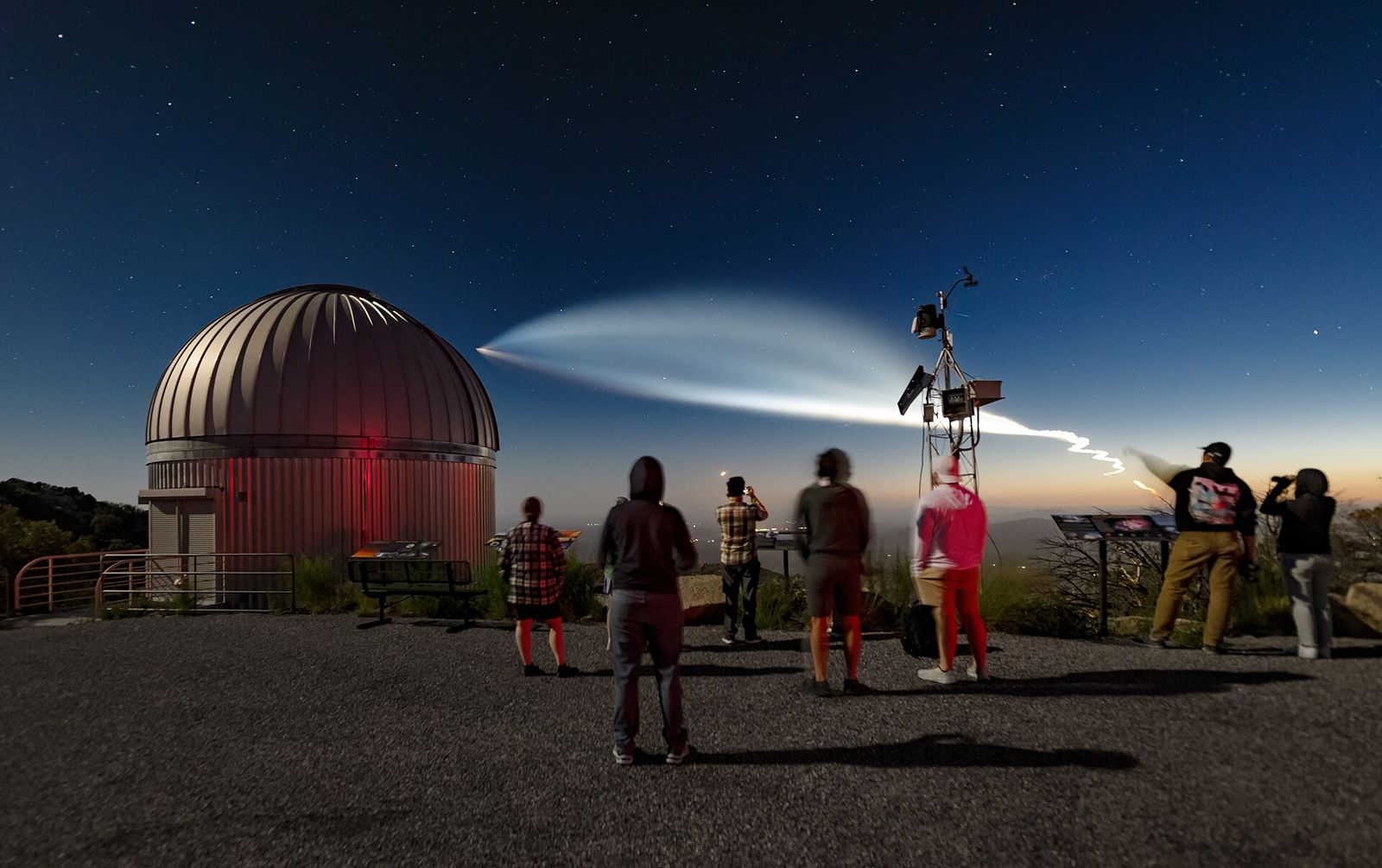 Rocket Launch Dazzles Kitt Peak Visitors (iotw2519a) — KPNO/NOIRLab/NSF/AURA/R. Sparks, CC BY 4.0, via Wikimedia Commons
We'll start on the launch pad, because SpaceX finally got a mission off the ground that had been slipping for almost a week.
On Friday afternoon, California time, a Falcon 9 launched the USSF-432 mission from Space Launch Complex 4 East at Vandenberg Space Force Base. SpaceX's own mission page gives liftoff at 4:48 p.m. Pacific time. Next Spaceflight logs it at 00:48 and 42 seconds UTC on Saturday, which is 01:48 Copenhagen time, early this morning while you were asleep.
According to Spaceflight Now, the flight was originally scheduled for November 1. It was delayed repeatedly, first because the Starlink 15-18 launch slipped and then for reasons that were not disclosed. If you've been following this show over the past week, you'll remember USSF-432 moving from one night to the next. It finally went.
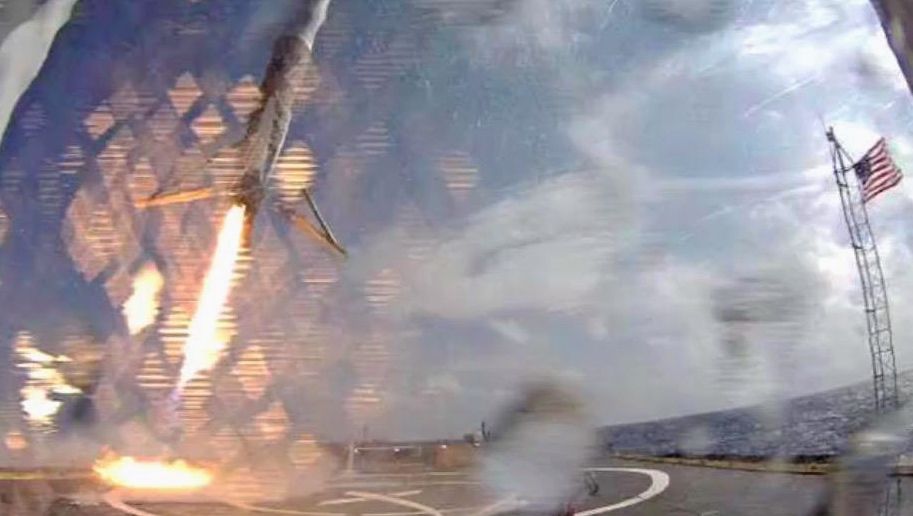
The booster was B1095, flying for the eighth time. SpaceX says it had previously launched GPS III-8 and six Starlink missions. Spaceflight Now adds that all of its earlier flights were from the East Coast, and that it was moved across the country after the GPS 3-8 mission in April. This time it landed on the drone ship Of Course I Still Love You, stationed in the Pacific off Baja California. Next Spaceflight counts that as the 336th consecutive successful Falcon landing.
So what was on board? Officially, almost nothing is known. Space.com reports that SpaceX cut its webcast about ten minutes into the flight, shortly after the first stage landed. Spaceflight Now says the mission is also called R-4 in public documents. It's the fourth in a series of "R" missions that began on August 16 with USSF-366, followed by USSF-153 in September and USSF-385 later that month. According to orbital catalog entries, each of those earlier R launches placed 23 satellites in orbit. They're thought to be based on Starshield, the government version of the Starlink satellite. Jonathan McDowell, the well-known launch tracker, says the R satellites belong to the Space Force's Space Based Sensing and Targeting program. Next Spaceflight makes a similar case, noting that the stage drop zones match earlier Starlink Group 15 launches exactly.
Neither SpaceX nor the Space Force has confirmed successful deployment on the earlier flights, and the Space Force has declined to give any information about the missions. So treat the payload description as informed outside analysis, not as an official statement.
A few numbers to put this in context. Space.com says USSF-432 was SpaceX's 125th launch of 2026, the 119th Falcon 9 launch of the year, and the 14th national security flight for Falcon 9 this year. Space.com also notes that more than seventy percent of this year's Falcon 9 missions have been dedicated to building out Starlink. Next Spaceflight lists it as the 702nd Falcon 9 mission overall. Vandenberg's own news office says it was the 74th launch the base has supported in 2026.
There was one small human touch. SpaceX warned that residents of Santa Barbara, San Luis Obispo and Ventura counties might hear sonic booms. And Space.com described the liftoff as a gorgeous sunset launch, rising as the sun sank toward the Pacific.
Part two: Starship Flight 15 and a new documentary
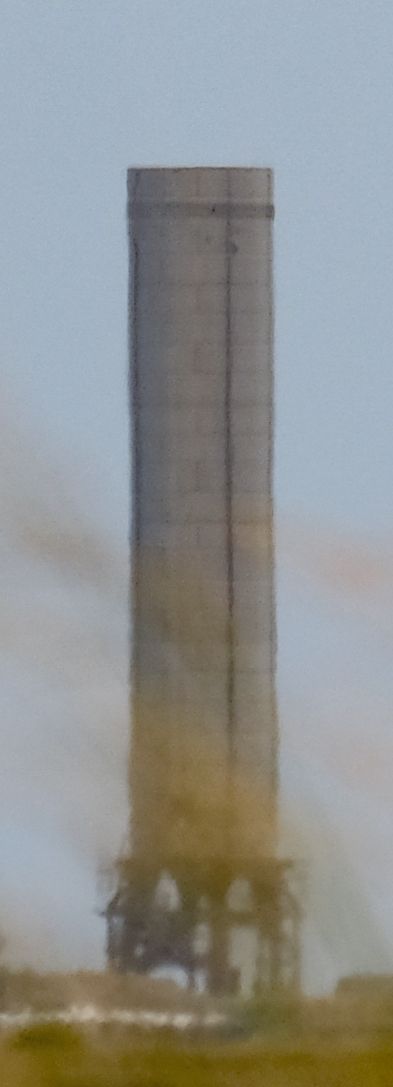 Super Heavy BN3 — Lars Plougmann from United States, CC BY-SA 2.0, via Wikimedia Commons
Now to Starship, where the date for the next flight is getting firmer.
KeepTrack and Ars Technica's Eric Berger report that SpaceX's vice president of launch, Kiko Dontchev, told the UP.Summit on Thursday that Flight 15 is targeting Friday, November 13. KeepTrack points out that this is the first launch target from a SpaceX executive, rather than from FAA air traffic planning slides. Those slides had previously shown no earlier than November 8 and then November 12. As of KeepTrack's report, SpaceX had not posted a mission page or a launch time. Pad Zero likewise notes that it's still not an official date.
Flight 15 matters because SpaceX plans to try catching the ship, the upper stage, with the launch tower for the first time. On the third-quarter earnings call, Musk said the flight would try to catch both the Super Heavy booster and the ship. KeepTrack quotes him calling a successful ship catch "more likely than not."
Musk repeated the timeline on Friday. Speaking at the Baron Investment Conference, as reported by Tesla North, he said, "So that's what we're going to do in about a week from now." Tesla North says the attempt is expected to involve Ship 42, which SpaceX has already tested with the tower's arms. Musk also talked about how hard the heat shield is: "It's an incredibly difficult thing to do, and it's something that we've been working on for a decade, basically. It's so hard." He said Starship could eventually bring launch costs below one hundred dollars per kilogram.
One more Starship item from Friday. SpaceX released "Go For Orbit," a 21-minute documentary about Flight 14. Tesla North describes it as the fourth chapter in SpaceX's Starship documentary series. It goes behind the scenes of the September 28 flight, when Starship reached orbit for the first time and deployed 26 Starlink V3 satellites. Tesla North recaps what made that flight dramatic. A Super Heavy engine shut down during the climb, and one of the ship's vacuum engines shut down early. The remaining ship engines burned longer, and controllers gave the go for orbital operations. All 26 satellites deployed, and the ship later made its first deorbit burn and splashed down in the Pacific.
Tesla North also makes a fair point: the film doesn't change the Flight 15 plan. Getting to orbit and deploying a payload are done. Reliable recovery and fast reflights are still the bigger goals.
Part three: SpaceX stock rebounds, and the FAA rewrites the rulebook
 SpaceX booster about to touchdown on their drone ship in the Atlantic (17149769351) — jurvetson, CC BY 2.0, via Wikimedia Commons
Let's turn to the markets, because Friday was a very different day from Wednesday and Thursday.
SpaceX, ticker S-P-C-X, closed Friday at $134.27, up $10.65, or 8.62 percent, according to Stock Analysis. In after-hours trading it went to $135.64, up about one more percent. That leaves the stock right around its $135 IPO price, which it has been hovering near for a week. For context, Thursday's close was $123.62, down 9.05 percent, and Wednesday's was $135.92, down 3.81 percent.
CNBC's Tobias Burns wrote on Friday that SpaceX shares fell nearly thirteen percent over Wednesday and Thursday after the November 3 midterms. Some on Wall Street see a risk of what CNBC called political "retribution" against Musk after big Democratic wins. Deutsche Bank analyst Edison Yu argued that the risk is more a matter of perception than reality. His reasoning is that nearly all of SpaceX's dealings are with executive branch agencies, which remain under Republican control. "While there are ways for Congress to interfere, nearly all dealings are conducted with executive branch agencies," he wrote. Yu reiterated a buy rating with a $250 price target. He also addressed Texas, which CNBC notes flipped blue at the governor level. Yu said "the vast majority of SpaceX's compute will be outside Texas in 2027," so he doesn't expect Texas data center obstacles to hit his near-term estimates.
Ron Baron, the longtime SpaceX backer, defended Musk on CNBC's Squawk Box on Friday. "A lot of [Democrats] who were elected have spoken negatively about Musk," Baron said.
The bigger catalyst on Friday, according to MarketWatch, was regulation. The FAA said it plans to reduce the regulatory burden on commercial launch and reentry licensing. MarketWatch's Natalie Weger reported SpaceX up 6.6 percent at midday on that news, before it finished up more than eight. Rocket Lab, Firefly Aerospace and AST SpaceMobile also surged on Friday, MarketWatch says.
So what exactly did the FAA announce? According to the FAA newsroom and to AIAA, it proposed three changes to its launch rules. One allows more flexible flight abort capability. One sets clearer thresholds for when an abort is required. And one changes how reentry debris risk is calculated. On top of that, the FAA announced a comprehensive overhaul of its licensing framework for 2027, along with more staff to speed up approvals. The stated goal is 1,000 launches and reentries a year by 2030. MarketWatch adds that the United States was responsible for 217 of the 329 commercial space launches worldwide in 2025. Reuters, via Investing.com, framed the proposed changes as a potential boost for SpaceX.
Now, an important caveat. These are proposals and plans. Proposed rules typically go through a comment period before they take effect, and the full overhaul is not scheduled until 2027. So this doesn't change anything about Flight 15's licence next week. It's a signal about direction.
There was one more SpaceX business story on Friday. Investing.com, citing Reuters, reports that Musk posted on X that government revenue will be less than ten percent of SpaceX's total revenue this quarter, down from 16.6 percent last quarter. He said it would fall below five percent a year from now. His full post read: "SpaceX contracts with the government are BOTH the best product AND the lowest price! Moreover government revenue will be less than 10% of SpaceX revenue this quarter and less then 5% a year from now." Investing.com notes that in 2025, government contracts were roughly a fifth of SpaceX's revenue. It also says Anthropic is now SpaceX's largest single customer, at more than a third of revenue, and that the AI business turned profitable for the first time last quarter.
It's worth thinking about the timing. That post came as investors were worried about political risk in Washington, and its message was essentially that SpaceX depends on government money less and less.
Part four: Musk at the Baron Investment Conference
Now to the longest Musk appearance of the day. On Friday he joined Ron Baron by video for an hour-long fireside chat at the 33rd Baron Investment Conference in New York. InvestmentNews places it at the Metropolitan Opera House, and Tesla North at Lincoln Center, which is where the Met is. There was a lot in it, so let's take it piece by piece. I'm relying mainly on Tesla North's full recap and on InvestmentNews.
First, revenue. Musk said the combined SpaceX and xAI business is "tracking to have an annual rate of revenue that is in excess of 100 billion dollars in December." He said the annual run rate could exceed $500 billion by December 2027, which he'd also said on the third-quarter earnings call. He was careful to frame it as a guess: "This not a promise. This what I think will happen. This my best guess." He even said $1 trillion in annual recurring revenue wasn't impossible, but he put the probability at only about two percent. Tesla North rightly flags that these are forward-looking projections, not reported results.
Second, data centers in space. InvestmentNews says Musk opened with a joke: "The pitchfork level for data centers is pretty high." That's a reference to the local opposition data centers face on the ground. His answer is to put them in orbit. He said, "there's a satellite with an NVIDIA GPU up there that we launched, and there's a satellite we recently launched with a Google TPU. And these are operating to the best of my knowledge - they're working fine in space." He said SpaceX expects to start launching the first StarMind computers, co-designed with NVIDIA, "probably – I'm just guessing here – but in the 3rd quarter of next year." That would ramp up to significant volume in 2028 and very large volume in 2029. His economic argument: "The cost of intelligence in space is dramatically less than the ground once you have a low cost per ton to orbit."
Third, Starlink. Musk said, "Version three satellite has over ten times the capability of version two satellite, and we'll be launching ten times as many of them." He expects Starlink's total bandwidth to rise about a hundredfold within two to three years, with another big jump coming from Version 4. He also floated an idea that connects to stories we've covered all week. "We could just acquire that legacy telco and use their spectrum, you know, ten times more effectively." Tesla North stresses that no acquisition target was named. Earlier this week we discussed reports that SpaceX was in talks about Boost Mobile, and Pad Zero notes analysts see hurdles there. So, to be clear, Musk talked about the concept, not a deal.
Fourth, Terafab, the planned Tesla chip fab. Musk said the goal is eventually to produce a terawatt of AI chips a year, which he estimates is roughly thirty times global production in 2027. "It's terrifyingly large," he said. He explained that the "tera" in Terafab refers to terawatts, not to Earth. On the risk, his words were, "if it fails, it'll be crazy, and if it succeeds, it'll be audacious." He confirmed that Tesla is building a research fab at Gigafactory Texas in Austin to experiment with new processes. The techniques that work would move to the larger Terafab plant planned for Grimes County, Texas. He claimed that research loop could compress "something that would normally take a year" to about a month. Tesla North adds that TSMC confirmed last month that it was in talks about a possible role.
Fifth, Optimus. Musk said "a minimum productivity expectation" for a humanoid robot would be five times a human's, because robots can run continuously. He estimated that 20 to 30 million capable humanoid robots could, in theory, match the productive output of the United States. When Baron asked whether Tesla would sell or rent Optimus, Musk suggested renting would probably be the preferred model. Tesla North notes that Tesla has no consumer ordering timeline for Optimus, and that Musk recently denied a report that reservations would open in December.
Finally, a personal note. The 83-year-old Baron asked Musk how he wants to be remembered. According to Tesla North, Musk said he hoped the reality would be that he "made a significant contribution in the furtherance of civilization."
Tesla North also gives some background on Baron's stake. In an April shareholder letter, Baron disclosed that his firm's SpaceX investment had grown to about $15 billion from an initial $1.75 billion. As of September 30, SpaceX made up 32.6 percent of long positions in the Baron Partners Fund, with Tesla at another 13.4 percent. So this was a conversation between a founder and one of his biggest believers, and it's worth hearing it in that light.
Part five: Tesla says goodbye to the Cybertruck
 2024 Tesla Cybertruck Foundation Series IMG 0634 (cropped) — Alexander-93, CC BY-SA 4.0, via Wikimedia Commons
Now Tesla, and the biggest product news of the day.
On Friday Musk posted on X: "Tesla will be winding down production of the Cybertruck at Gigafactory Texas around the middle of next year to make room for increased Cybercab production." That quote comes from Al Jazeera, working with Reuters. Replying to a user on X, Musk called the Cybertruck the "best vehicle Tesla has ever made" and spoke of the "end of an era."
The numbers explain why. Al Jazeera notes that Musk originally predicted the Cybertruck would sell about 250,000 a year. About 38,965 were sold in 2024, and that fell by nearly half in 2025, to 20,237. Al Jazeera adds that Musk didn't say whether production would move to another factory, and Gigafactory Texas is the only known production site. MarketBeat summarizes the background as falling Cybertruck sales, quality issues, delays and recalls.
NBC News, citing Reuters, collected some reactions. Former Aston Martin CEO Andy Palmer said continuing production made no sense given the missed targets. Automotive analyst Felipe Munoz said electric pickups in general have underperformed in the U.S. He also noted that the Cybertruck's design and pedestrian safety rules kept it out of Europe. That last point is the one most relevant to us in Denmark: the Cybertruck was never sold here, so this ending is mostly an American story. The BBC headline put it as Musk appearing to signal the end of the road for the truck. Ars Technica was blunter, calling it "the angular metallic flop."
The strategic story is the Cybercab. Tesla is freeing up factory space for the two-seat robotaxi. That's a bet that autonomous ride-hailing will matter more to Tesla than a niche pickup, and the factory floor is being reallocated to match.
Tesla stock rose. TSLA closed Friday at $358.22, up $14.53, or 4.23 percent, according to Yahoo Finance. It traded between $347.60 and $363.84 and added about a third of a percent after hours, to $359.40. Volume was about 36 million shares. MarketBeat says that was about 28 percent below average, and it attributes part of the move to a rebound in EV stocks after a recent selloff. MarketWatch put the gain alongside the Cybertruck news.
Here's the context for the week. Thursday was ugly: Yahoo's data shows TSLA fell from $385.19 to $343.69, down 10.77 percent in a single day. Wednesday was down 3.34 percent and Tuesday down 1.32 percent. So Friday's gain recovers only part of the week's losses. Tesla started the week above $400 and ends it below $360.
MarketBeat lists the analyst consensus price target at $414.51. It also mentions some near-term caution: Zacks has cut earnings estimates for late 2026 and early 2027, and the latest quarterly revenue came in slightly below estimates and down year over year.
Part six: Starlink odds and ends
 Starlink über dem Rathaus in Tübingen — Dktue, CC0, via Wikimedia Commons
A few quick Starlink items from Pad Zero's news feed.
On November 6, Starlink said Router 4 is now shipping with Starlink V4 kits in the United States and Canada, on the Residential 200 megabit and Residential Max plans.
Also on November 6, Starlink invited U.S. adults to create a 30-second English-language ad with Grok Imagine, for a chance to be featured during "the big game," meaning the Super Bowl. Submissions close November 29.
And KeepTrack's latest count, based on its November 2 update, puts the constellation at 13,096 Starlink satellites launched in total. Of those, 11,214 are still in orbit and 11,200 are working, while 1,882 have reentered.
Part seven: Blue Origin, Rocket Lab and Firefly
 New Glenn launch signals new era for Space Launch Complex 36 (8832112) — U.S. Space Force 45SW by Senior Airman Samuel Becker, Public domain, via Wikimedia Commons
Now to the other launch companies on our watchlist, starting with Blue Origin.
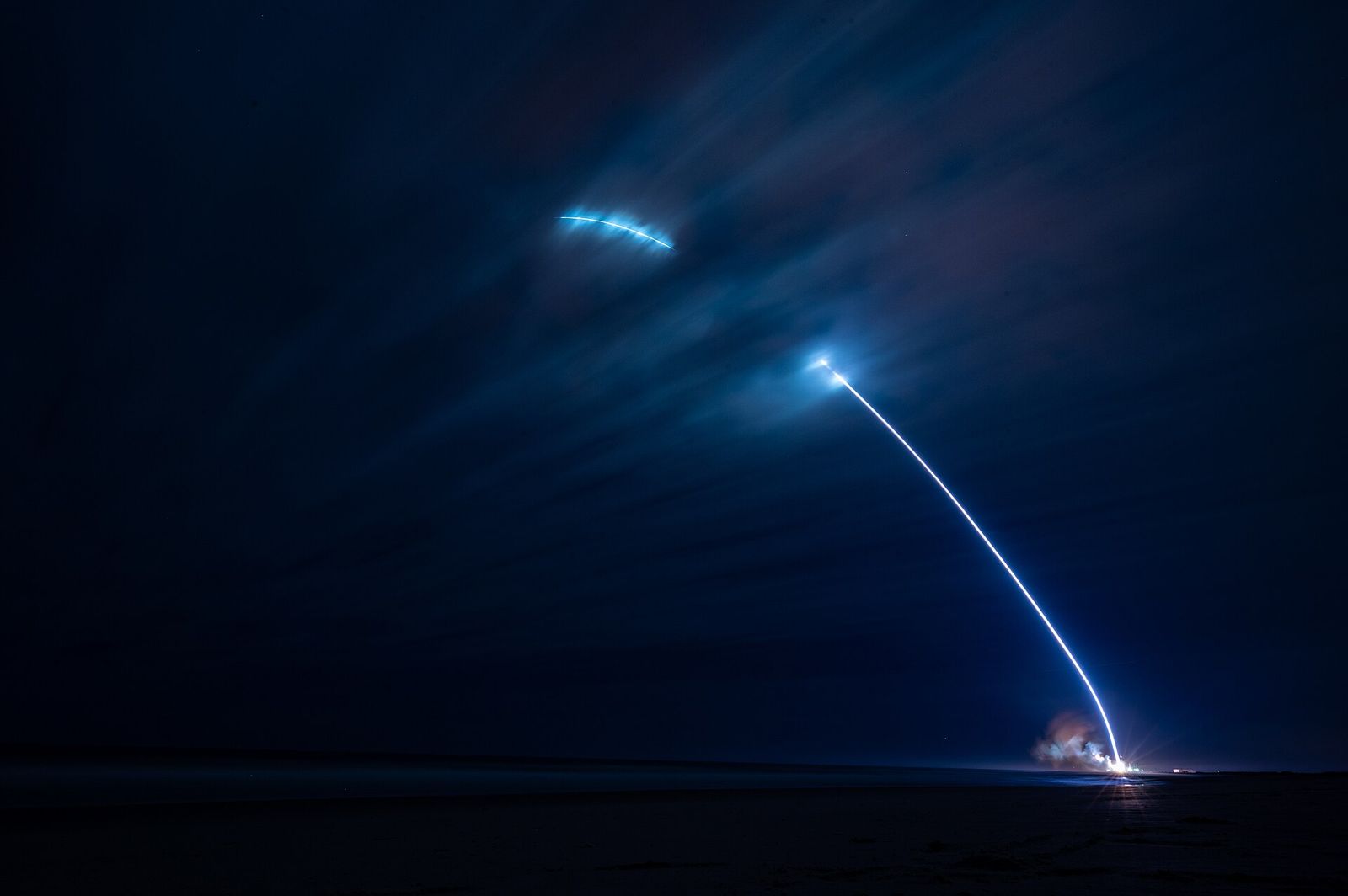
New Glenn won't fly again this year. The Register says it viewed an internal memo from CEO Dave Limp: "We're proactively updating our anticipated launch date to January 2027." Bloomberg, via Ars Technica's Rocket Report, says Limp told employees on Wednesday. New Glenn has been grounded since it exploded during a ground test in May, which heavily damaged the launch pad at Cape Canaveral. In June Limp said they still planned to fly again this year. The memo says the team "found and fixed the issue that caused the anomaly." In August Limp had said the problem started at the main oxygen valve on one of the BE-4 engines.
Ars calls the slip "minor and widely expected," and points out that January would still be well ahead of early fears about how long rebuilding the pad would take. After the return to flight, the manifest gets busy, including a spring launch of the Blue Moon Mark 1 lander. The Register notes that the slip leaves less margin before NASA's planned Artemis III demonstration mission next year, which involves lunar hardware from both Blue Origin and SpaceX.
Blue Origin also had two hardware announcements. The first is Northstar, a new booster engine meant to eventually replace BE-4. According to The Register and Ars, it has half the parts and thirty percent less mass, and thrust rises from 640,000 to 715,000 pounds-force. Ars adds that about 65 percent of it can be 3D printed, and that Blue Origin thinks it can build it for about a quarter of the cost of a BE-4. The second is GS3, a hydrogen-oxygen third stage for high-energy missions such as direct injection into geostationary orbit and Earth escape. Blue Origin says GS3 is already under contract for a cislunar mission with a government customer in 2028. Ars notes that it uses a lightweight composite hydrogen tank, and that Blue Origin recently completed its first composite liquid hydrogen tanking test in Texas. Ars also says Blue Origin's longer-term ambition is to position New Glenn to fly more than a thousand times a year. That number lines up nicely with the FAA's new target, though for now it's an aspiration.
Next, Rocket Lab. The big news, that Neutron's first launch has slipped into 2027, came out last month. Rocket Lab's own October 14 update and Aviation Week explain the cause: air voids between carbon-fiber layers in the propellant tank domes of the reusable first stage. According to Ars and others, the voids formed while curing thicker laminate sections outside an autoclave. Those thicker sections had been added after an earlier tank rupture. The aft dome has since passed inspection, but a new forward dome has to be built and inspected, and the full stage tested, before Rocket Lab sets a date.
What's new this week is investor attention. A Simply Wall St analysis published on Yahoo Finance on Friday notes that Electron and Space Systems are "carrying the load as Neutron burns cash." It also mentions the pending Iridium acquisition and Rocket Lab's push toward its 100th Electron mission. The next marker is the earnings call on November 9, this Monday, where investors want clarity on Neutron's timing and cost. Via Satellite also ran an opinion piece Friday titled "Rocket Lab's Setback Shows Why Space Needs More Launch Providers." And as MarketWatch reported, Rocket Lab shares were among the space stocks that surged on the FAA news.
Then Firefly, which had a big day. Firefly announced a three-year agreement with AST SpaceMobile worth more than $1.3 billion. Firefly will deliver 36 rocket engines for AST SpaceMobile's first three heavy-lift rockets: 27 Miranda engines and nine Vira engines, the vacuum version. Firefly will also license the engine's intellectual property so AST can build the engines itself, and provide engineering support. Payment is a mix of cash and AST stock, with the stock subject to lock-up periods. Firefly says Miranda is a 230,000 pound-force engine that has completed more than 175 hot-fire tests totaling over 4,200 seconds.
Firefly CEO Jason Kim called it "a bold transformational deal." He said, "When a company sets out to build its own rocket, the engine is the hardest, highest-stakes decision they make." AST founder Abel Avellan described Firefly as "one of a few companies in the United States with a proven liquid engine of this scale." Firefly says it keeps full ownership of the engine IP and will use the money to expand hiring, buy long-lead materials, and add test bays at its Rocket Ranch in Briggs, Texas. It will discuss the deal on its third-quarter earnings call on Tuesday, November 10, at 5 p.m. Eastern, which is 23:00 Copenhagen time.
This deal ties into a theme Ars has covered all week. Quilty Space estimates that outside China there will be a shortfall of about 150 launches compared with demand between now and 2030. It could be roughly double that if U.S. military demand is added and SpaceX doesn't extend Falcon to cover it. Quilty's Caleb Henry said, "the launch crisis is more severe than we thought and that it will not go away this decade for sure." When a satellite company like AST decides to build its own heavy-lift rocket, that's one response to that shortage.
On the rest of our watchlist I don't have anything to report from the last twenty-four hours. That includes Relativity Space and Terran R. On the Danish side, my search found GomSpace's recently reported third-quarter numbers, which it describes as continued profitable growth, along with a target of 1.6 billion Swedish kronor in revenue by 2030. I couldn't confirm that the report fell inside our window, so take it as recent background. Space Inventor says it will exhibit its BIG CAT satellites and BIFROST at Space Tech Expo Europe in Bremen, November 17 to 19. Terma has been credited with spacecraft testing and checkout systems for ESA's MTG-I2 weather satellite. I'll dig into all three properly if any of them makes real news.
Part eight: China and the rest of the world
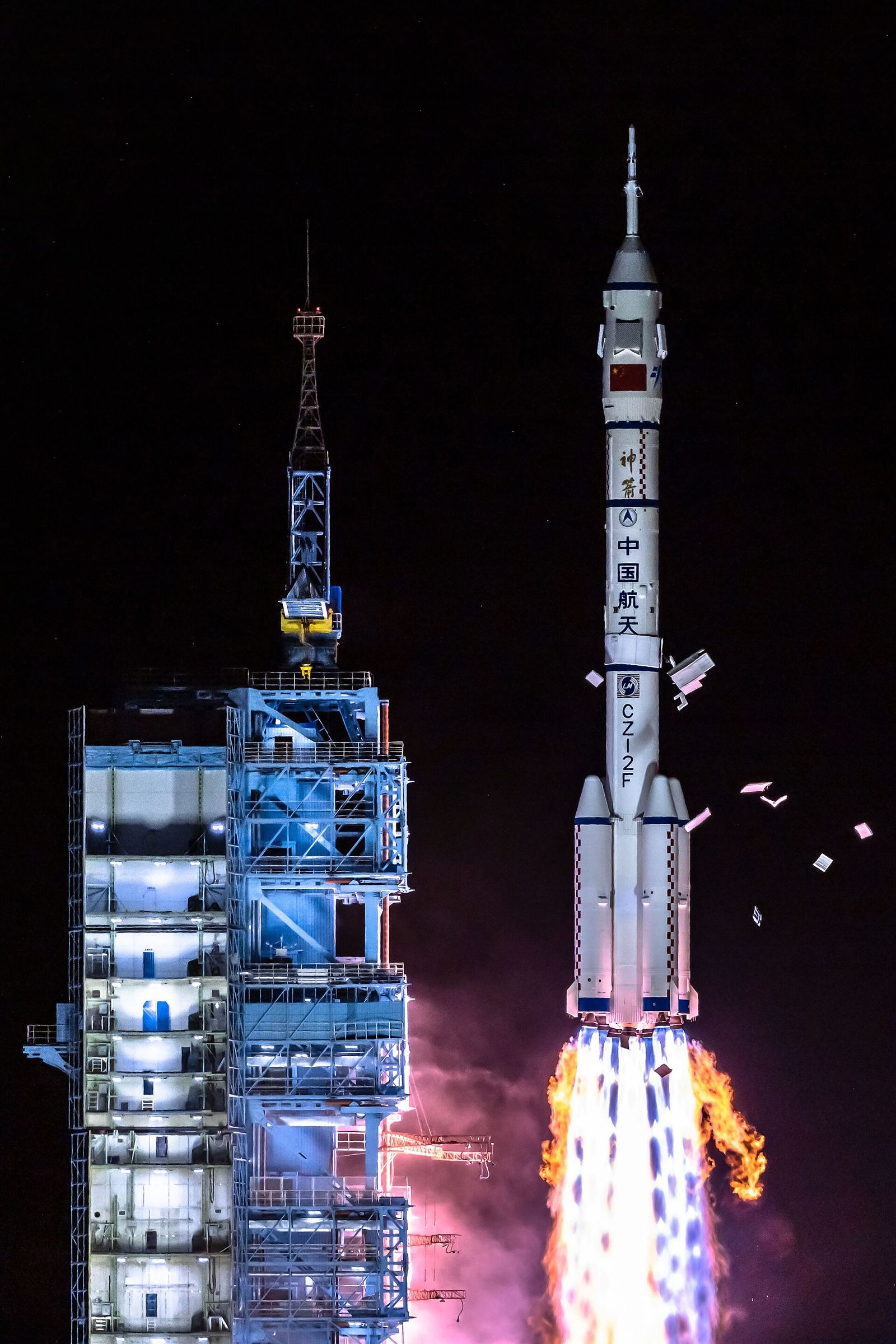 Launch of Shenzhou 13 — Created by ForrestXYC, photoshopped by Ib, CC BY-SA 4.0, via Wikimedia Commons
Over to China, where it was a busy night.
Galactic Energy's Ceres-2 rocket returned to flight. Xinhua and China Daily report that it launched from the Jiuquan Satellite Launch Center at 7:37 a.m. Beijing time on Saturday. That's 00:37 Copenhagen time, just over an hour before the Falcon 9 from Vandenberg. The rocket placed four satellites into a 535-kilometer sun-synchronous orbit. They're named Guanlan Experimental, Yunyao-1 28, North China University-1, and Juntian-1 06A. The Global Times and China in Space both describe it as a return to flight. Ceres-2 Y3, its third flight, carried customer satellites.
Ars Technica's Rocket Report, published Friday, also covers some Chinese stories from earlier in the week. CAS Space flew its Kinetica 2 rocket for the second time, its first operational flight, carrying 18 satellites for the SpaceSail, or Qianfan, constellation. Ars calls Kinetica 2 a "mini-Falcon Heavy": it has three side-by-side boosters like the SpaceX rocket, but only three kerosene engines per booster instead of nine. It can lift about 12 metric tons to low Earth orbit. According to Ars, SpaceSail now has about 275 satellites, out of a first phase of 1,296.
And China has laid out its most detailed roadmap yet for landing astronauts on the Moon "before 2030." That comes from the Seventh Manned Spaceflight Conference in Beijing, as reported by Ars. A demonstration flight of the single-core Long March 10A with the new Mengzhou crew ship is planned for early 2027, going to low Earth orbit. The full three-core Long March 10 is set to send the Lanyue lander on an uncrewed lunar test in 2028. A dual-launch rehearsal would follow in 2029. Then, before 2030, a crewed dual launch would lead to the landing.
The Rocket Report also lists a Long March 12 carrying a batch of SatNet satellites to low Earth orbit, scheduled from Wenchang on November 8 at 20:25 UTC. That's 21:25 Copenhagen time tomorrow evening.
Two quick items from elsewhere. In Japan, Interstellar Technologies has won backing from JAXA's commercial launch demonstration program for its Zero rocket. Aviation Week, via Ars, says grants under that program go up to $76 million per company. Zero is designed to carry about one metric ton to low Earth orbit, with a first launch currently pointed at 2027. In India, Ars recaps the October 30 GSLV launch of NVS-03, a satellite that restores India's regional navigation system. It carries several atomic clocks of different designs, because older satellites in the fleet suffered clock failures.
Part nine: NASA
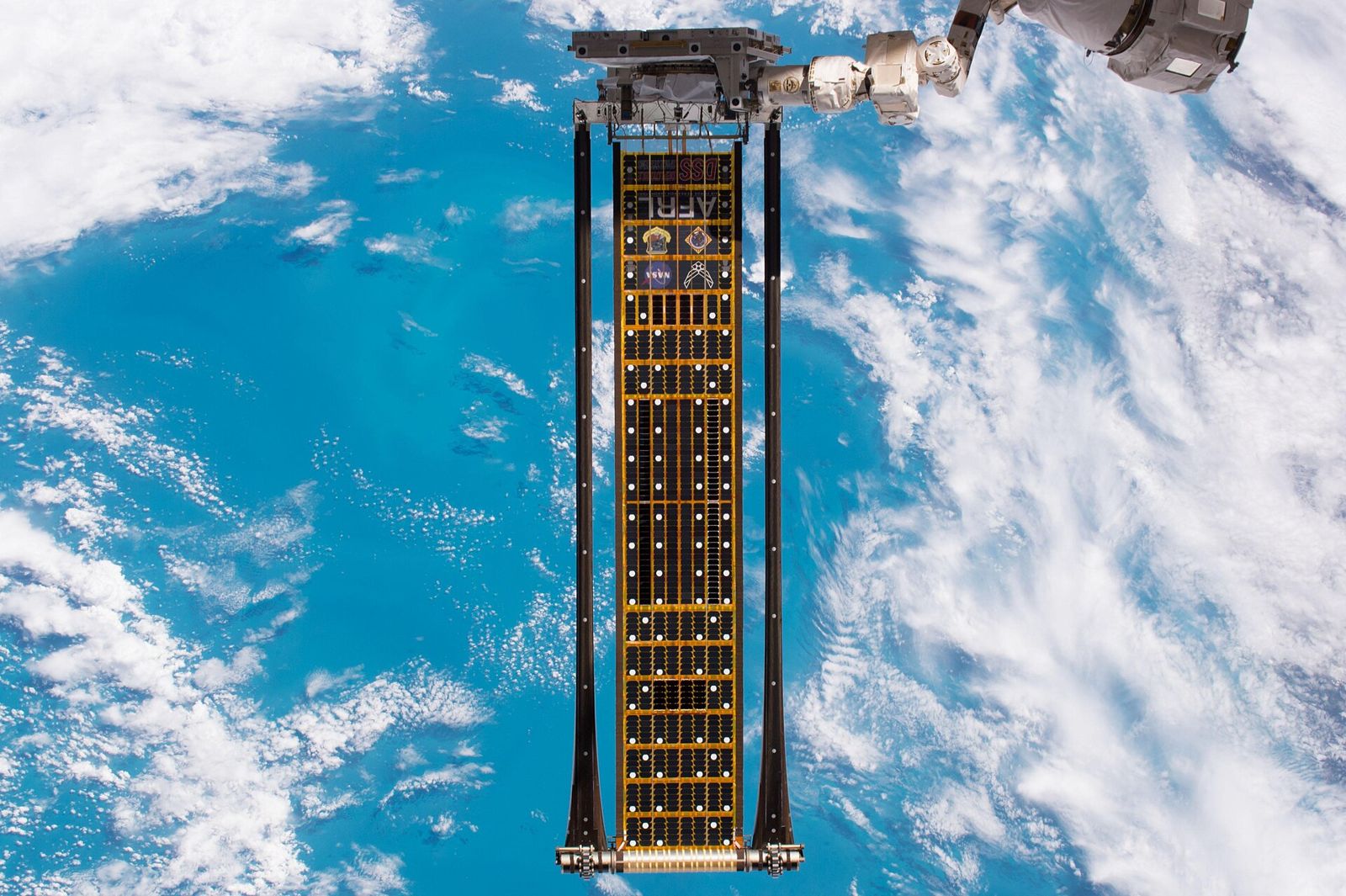 ISS-52 Roll Out Solar Array (ROSA) (4) — NASA, Public domain, via Wikimedia Commons
Now to NASA, which had two pieces of news this week.
First, NASA has picked the companies that will help replace its aging Tracking and Data Relay Satellite System. That's the network of relay satellites that has carried data from the space station, Hubble, and many other missions for decades. SpaceNews and NASA's own release say NASA selected Astranis, Global Enterprise Solutions, and Viasat to develop commercial Ka-band relay concepts, with contracts worth up to $1.07 billion in total. Astranis put out its own announcement, describing it as part of NASA's NEXUS Ka-band relay initiative. This is the same commercial-services model NASA now uses for cargo, crew and lunar landers, applied to data relay.
Second, the space station has its full set of new solar wings. India Today reports that during a U.S. spacewalk on Thursday, November 5, NASA astronaut Anil Menon helped install the final Roll-Out Solar Array. That raises the station's power capacity from about 160 kilowatts to about 215. This spacewalk was just before our twenty-four-hour window, but it was the end of a long project, so it's worth mentioning. These arrays are the same rollable design we discussed a week ago when the IROSA spacewalk was coming up.
And a bit of Artemis science. Space.com, via the Rocket Report, describes a study by researchers at National Cheng Kung University in Taiwan. It found that the Artemis II launch in April caused larger disturbances in Earth's ionosphere than any other rocket launch measured so far, possibly enough to cause temporary, local GPS errors. Strangely, the disturbances were up to ten times stronger than those from Starship test launches, even though Starship has about twice the liftoff thrust of SLS. The researchers rebuilt the picture from high-precision ground GPS networks, and we don't yet have a full explanation for why SLS stood out.
Part ten: Astronomy to end the week
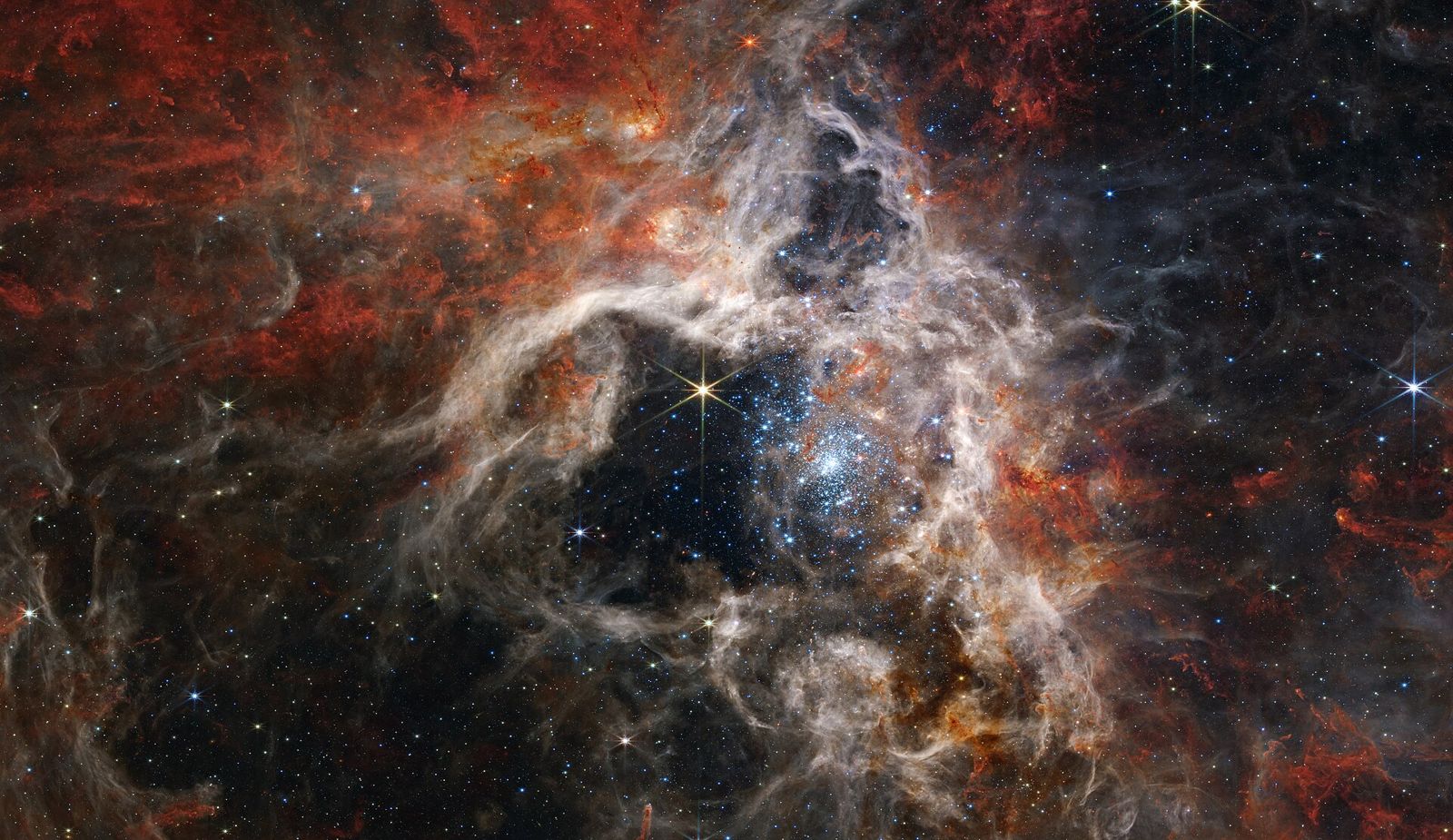 Tarantula Nebula by JWST — NASA, ESA, CSA, STScI, Webb ERO Production Team, Public domain, via Wikimedia Commons
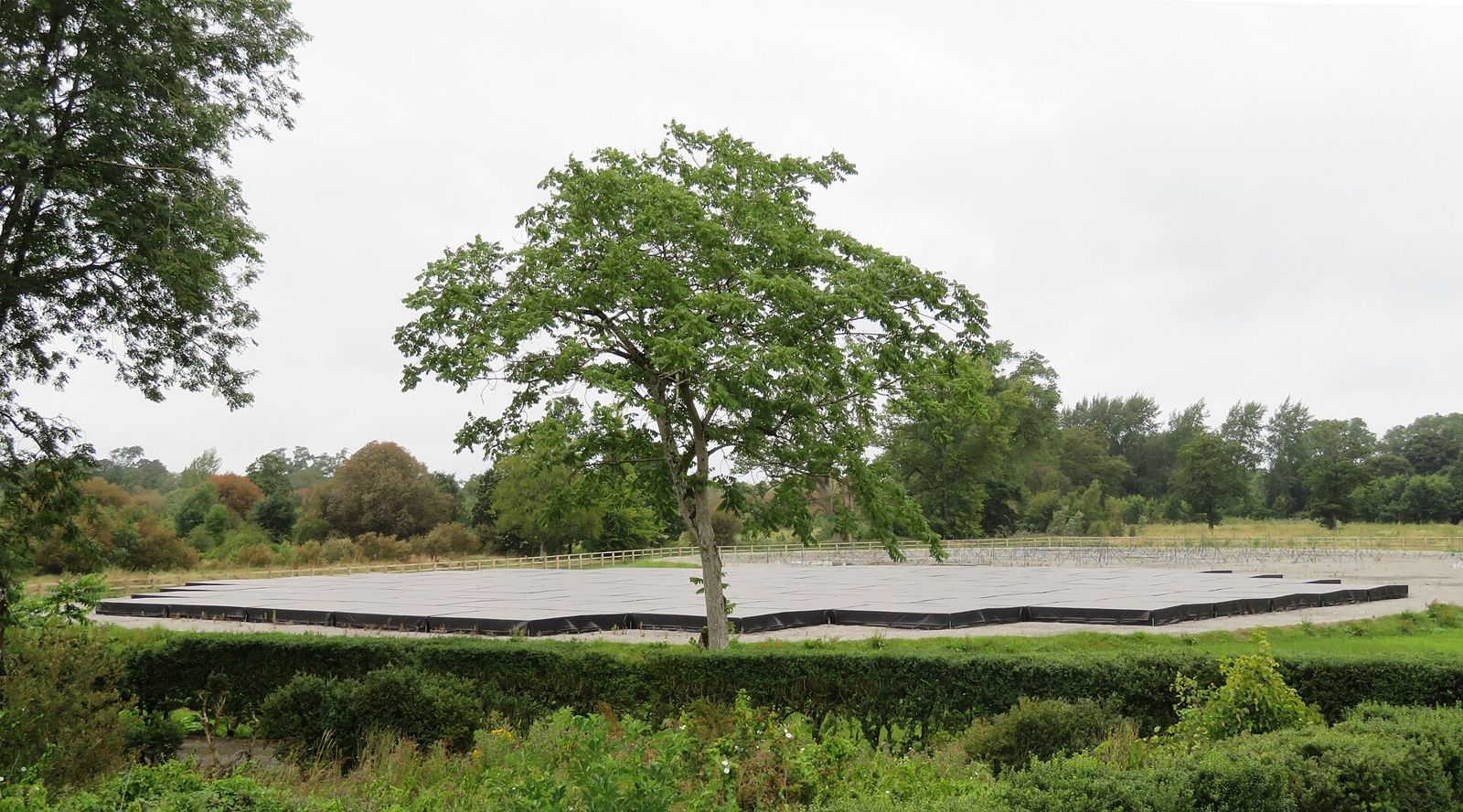 I-LOFAR telescope — O'Dea, CC BY-SA 4.0, via Wikimedia Commons
Let's finish with the sky. A few results from this week stood out.
From the Netherlands, Leiden University reports that astronomers have created the sharpest and most sensitive low-frequency radio image of the sky to date, using the LOFAR telescope network. The image contains nearly 63,000 radio sources. LOFAR has stations across Europe, so this is very much a European achievement.
From the James Webb Space Telescope, Phys.org describes a distant galaxy nicknamed "Misty Moons." It offers a glimpse of early star formation, with stars forming in intensely clustered pockets. It's another example of Webb showing that young galaxies were often clumpier and busier than the smooth spirals we see nearby.
Hubble, now in its fourth decade, has done something new. AAS Nova reports Hubble's first detection of a rocky exoplanet's secondary eclipse, the moment when the planet passes behind its star and its light briefly drops out of the combined signal. The planet is TOI-2431 b. Measuring that dip tells you how much light the planet's dayside gives off, which tells you about its temperature and whether it might have an atmosphere.
In Nature, a team reports a new imaging method that photographs exoplanets below what they call the telescope's stability limit. They used it to make the first image of the young giant planet 51 Eridani b at a wavelength of 4.3 microns. Directly imaging planets is extremely hard because the star is so much brighter, so a technique that gets around a telescope's own wobbles is a real step forward.
And for ALMA, the big radio array in Chile, the Japanese ALMA team describes an imaging tool called PRIISM. It has revealed previously hidden rings and gaps in protoplanetary disks, the dusty disks where planets form. Gaps in those disks are often taken as signs of young planets clearing their paths.
Wrap-up
That's the Saturday edition. Let's recap the main points.
USSF-432 finally flew from Vandenberg at 01:48 Copenhagen time, with booster B1095 landing on Of Course I Still Love You. It's believed to be the fourth batch of Starshield-based sensing satellites, but none of that is official. SpaceX is targeting November 13 for Starship Flight 15 and its first attempt to catch a ship with the tower, and Musk says it's about a week away. SpaceX stock rose 8.6 percent to $134.27, right around its IPO price, helped by FAA plans to streamline launch licensing toward a thousand launches a year by 2030. Musk told Ron Baron that the combined SpaceX and xAI business is tracking toward a $100 billion annual revenue rate by December. He also said StarMind orbital computers could start launching in the third quarter of 2027. Tesla is ending Cybertruck production around mid-2027 to make room for Cybercab, and TSLA rose 4.2 percent to $358.22 after a very rough Thursday. Blue Origin has pushed New Glenn's return to flight to January and unveiled Northstar and GS3. Firefly signed a $1.3 billion engine deal with AST SpaceMobile. And Rocket Lab reports on Monday.
The weekend is fairly quiet. The things to watch next week are Rocket Lab's earnings on Monday, Firefly's on Tuesday, and Starship Flight 15, currently targeted for Friday the 13th.
Thanks for listening, and enjoy your Saturday.